Tuesday, November 8, 2011

Road Trip!

Aaron and I just got back from a five-day weekend in the great state of Indiana, as we attended our friends' wedding (Yay Erin and Adam!!) and got into some other antics. Thoughts and highlights:

  • Indiana - at least, the part we were in - is so scenic this time of year! I felt like I was living inside of a postcard photo. But did I think to take pictures of the scenery? I did not.
  • The wedding was beautiful, and I DID remember to take pictures of that.
  • I also made sure to snap a picture of this banner at the church. I know that our friends did not personally select this to adorn the church wall for their wedding, so I feel (relatively) safe in saying... wow. Red eyes, pale skin, and outstretched bloody hands? You decide what that means.
  • In the olden days before I had this certain type of diabetes-centric confidence, I would have balked at wearing a dress to a wedding. (Why? Because dresses don't generally have nifty pockets to house various diabetes paraphernalia. I felt condemned to pants.) This weekend was an occasion where I felt comfortable in my own skin, so to speak. My insulin pump was hooked onto the front of my bra, my Dexcom receiver was stuffed into the side, and my confidence was on the dance floor. And guess what? No one noticed the robot parts. (Well, they didn't notice until later in the evening when I made it a point to be all blatant and "look at how MacGyver I was tonight!" about it with some of the bridal party - whom I had met for the first time that weekend. There may have been some wine involved earlier in the night.)
  • Being in Indiana also meant that Aaron and I got to grab some lunch with some DOC friends - Cherise (and her daughter) and Mike (and his wife)! We decided that while we were together, we should do a Big Blue Test by testing, walking around downtown Indy's Monument Circle, and testing again. Want to know what the Big Blue Test is and how you can do it, too? Go check out http://www.bigbluetest.org/ for more info! (There also may be video evidence of our walk and results coming soon. Maybe.)
  • Indiana has both Dunkin' Donuts and Chick-Fil-A, which meant that Aaron and I both got to satisfy our less-than-healthy food cravings. We also tried Steak 'n Shake for the first time. We were less than impressed. 
  • Since Eli Lilly has a huge campus right by the part of downtown we stayed at, I was hoping to swing through and take a look. (Because that's what normal people do on vacation, right? Visit the pharmaceutical companies that make their life-saving medication?) Unfortunately, the Colts game foiled our plans and this is as close as I got. (Also, I have no idea why this bullet point is centered.)

  • The hotel we stayed in Saturday night is housed inside of Indianapolis' historic Union Station, which meant that the hotel actually had (non-working) train cars in it. What's that? You want to know if I was totally solemn and serious while standing on one of the train car's steps? 

In short: we had a great time. :)

Disclaimer: Lilly did not ask me to visit them or mention them in this post. I wanted to go because I'm a huge nerd who will make special travel plans to accomodate diabetes-centric tourist destinations. Like you do.

Friday, November 4, 2011

Filling Gaps And Taking Risks.

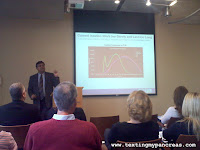
On Sunday, I attended a JDRF Research Update Event in Omaha, Nebraska. Speakers included Linda Johnson, MPA, CLP (Senior Director of Strategic Alliances) and Dr. Sanjoy Dutta PhD (Director of Glucose Control; Treatment Division), and though some of what was covered were things I'd already learned from previous JDRF webcasts and announcements, I did pick up a few things to think about. It's also nice to be able to talk to folks in person, so there's that. :)

Before I get into the recap, I want to say that I wish more people would have/could have attended. It's not very often that a Midwest city like Omaha gets to have people of this caliber to come speak. I wish the event could have been better promoted (and with much more notice given), as I felt the 40 or so of us that attended were not nearly as many who would have, had they know about this (and had they realized how unique this opportunity was). Attendance was low, and for that, I'm a bit sad.

Anyway. *cough* Onto the recap.

Linda Johnson spoke about the alliances JDRF has forged with governments, with other disease advocacy organizations, and with industry. She acknowledged that this is a relatively new direction for JDRF (she dated the beginning of such alliances as 2005), and emphasized that these partnerships and agreements can help us more expediently reach better treatments and eventually a cure. Alliances not only can provide a way to pool resources (monetary, knowledge and capabilities) to accomplish what one organization alone may not, they also help minimize unnecessary duplication in the areas of research and development.

She mentioned partnering with the Canadian government to secure funding for research ("Hey, if they want to give us $20M to do clinical trials there, we're not turning that down!"), and spent a great deal of her time speaking about the various industry alliances JDRF has entered into.

(I should also note that she made sure to point out that while many have expressed concern over the money JDRF puts towards these ventures, in the last fiscal year [FY11], just 10% of research funding when to industry partnerships. To me, that's a rather small amount, considering what it COULD be.)

There was talk of Merck/SmartCells, Amylin, Lilly and the University of Geneva research lab, Selecta BioSciences (whose focus, prior to JDRF's influence, had been on nicotine control) and iCo (who is working on repurposing existing meds for the treatment of diabetic macular edema). Linda pointed out that industry partnerships are critical to JDRF's mission: "You reach a point where you can only take your research so far, and need an industry partner to take things to market". (For more on those alliances, please click on those hyperlinks.)

Next up: Dr. Dutta. (I'm also going to say here that I think JDRF has done a great job of putting researchers who are able to put things in understandable terms in touch with the diabetes community. It can't be easy to translate things so eloquently, but people like Dr. Dutta are able to do just that.)

The work Dr. Dutta is involved in (treatment therapies) has two goals: to restore glucose regulation (think Artificial Pancreas [AP] and Glucose-Responsive Insulins [GRI]), and to discover, develop and deliver therapeutics that prevent, reverse and treat complications in all stages and all individuals with type 1. He talked a bit about the AP, and the recent news that patients in Europe have, for the first time ever, successfully used the AP in a real-world setting - that's big news!

He addressed some of the "gaps" that need to be filled when it comes to the physiology of a person with type 1 diabetes. Insulin production isn't the only thing "broken" - the production (and body's decisions for appropriate use) of hormones like glucagon, amylin and leptin are also affected. In a person with type 1, glucagon is present in the "wrong place at the wrong time" - meaning that it's missing when we're low and present when we're high. The fix here can't be to simply shut off glucagon production; a balance of suppressing and activating is needed.

Insulin delivery was another key topic. Dr. Dutta pointed out that current insulin delivery methods, which have insulin arriving in the body subcutaneously (meaning, under the skin), don't make a lot of sense. Think about it - in a healthy human body, does insulin get produced under the skin? (Nope - pancreas.) Does it do it's work under the skin? (Nope - it has to get to the blood stream.) Intra-dermal delivery techniques (which would engage more blood vessels) would also eliminate some of the more common complaints we insulin pump users have, as no tubing would mean no occlusions, kinks, etc.
Graph of how insulin works in a
non-diabetic person (that's in green)
and someone administering a
current insulin (in pink). Notice
how we're missing that big spike
of insulin at the start?
Another idea along those lines would be what's called an InsuPatch. Have you ever taken insulin and soon after gotten in a hot shower or hot tub? Insulin works REALLY fast then, right? Well, same idea - put a bandaid-like warming device around pump infusion sites. (I had to laugh when Dr. Dutta was explaining this one - "This is so simple; we looked at each other and said, 'Why didn't we think of this before??'".)

And lastly, the "high risk" project: glucose-responsive insulin (GRI). What needs to get accomplished here is that GRI needs to mimic physiology (deliver insulin when and where its needed), be device-free (limiting fingersticks, replacing insulin pumps, and reducing human intervention), and also address the critical gaps in type 1 treatment. Basically? It needs to reduce the burden of managing the disease, big time. (That... yeah. That would be nice.)

You may already be aware, but JDRF introduced a prize incentive related to GRI as a way to engage a new audience of experts. Dr. Dutta explained that while offering a prize in this arena is unorthodox, it was necessary: "If this were easy to develop, we'd have it already. People have spent time and effort trying to develop GRI but keep failing at it. We need people outside of the "usual suspects", and offering this prize can help us engage with those people."

Dr. Dutta left us with these thoughts: if something works (treatment-wise), jump on it. Your best defensive strategy is knowledge, so do your research. You can't expect your medical team to know about everything that's out there, so be an advocate for your own health by being engaged in learning about your disease.

And in summary: all of these technologies may not be suitable for each patient. We all have our own unique pathology, and we hope to get to a position where we can pick and choose from these advanced treatments, so that everyone can do what works best for them as individuals.

Thanks again to Linda Johnson and Dr. Sanjoy Dutta for spending a little bit of time with us here in the Cornhusker state. I hope they come back again soon.

Disclosure: JDRF did not specifically ask me to attend this event or talk/write about it. I was not compensated for my time there or for writing this recap. I am just super nerdy and like to learn (and then share) things like this. As per uzh, my opinions (and translation/recall of events) are my own.

Thursday, November 3, 2011

It's A Scary Place.

I'm writing this at a time when I've usually been asleep for a couple of hours, so bear with me.

I read this post from Jeff, and it got me thinking about the choices and trade-offs we make as people with diabetes. It got me thinking about the way that everyone's pathology is a little different, and how we all have different capabilities, resources, and preferences when it comes to how we maintain our health.

It got me thinking about how no matter what we choose - whether it's food, medication, delivery of that medication, timing of injections, amount (or lack) of exercise - we never really know if what we chose was right.

The unknown is a scary place to be pedaling toward, especially when it comes to your health.

For instance, I've been known to enjoy a Splenda packet or nine with my morning coffee allotment. I do that to avoid bolusing, to avoid excess sugar intake, and frankly I do it because artificial sweeteners were what I grew up using. (Real sugar didn't fit into that "exchange diet" too well. And by that, I mean not at all.) Those advantages are great, until I read an article on MSN about how I'm polluting the earth's water supply with my post-coffee pee. What if sucralose ends up being what does me in? (And how ironic would that be?)

It happens with every decision we make. Do I go low-carb, or eat how I want to eat and just dose for it? Do I aim for a smaller standard deviation of blood sugar, which may run higher, or aim lower and risk the hypoglycemic excursions? Do I exercise, even when I know I'm going to have to inhale all of those calories right back? Is it worth it?

How do we know that any of these decisions we make will ensure good health, and even if they do, for how long?

We'll spend our whole lives not knowing, until the one moment that we finally do.

It's a scary place.


Wednesday, November 2, 2011

Wordless Wednesday: Commissioned or Coincidence?


(This print is from outsidepeg.com. While this piece was not commissioned, they do offer that - just sayin'.)


(But for serious - it's uncanny, right?)


(Not so "wordless". I know.)

Tuesday, November 1, 2011

T1Day.

It's November 1st, which the JDRF is now proclaiming as "T1Day". We're asked, as a community of people living with diabetes, to "raise awareness about type 1 diabetes on this day and throughout the month of November".

It also seems to mark a turning point in how JDRF is engaging the adult type 1 audience, as you'll surmise from the cheeky (and perhaps, to some, over the edge) videos they've put out recently.


As someone who is an adult (and I use that term loosely) with type 1, I do appreciate JDRF's efforts to engage the adult population - adults make up around 85% of the type 1 population, after all. It's a fairly large shift to now see adults with type 1 in their advertising and promotion.

I also appreciate their attempts to educate the public about the different types of diabetes.

This new strategy is unorthodox and frankly, a little bit shocking - how many disease advocacy groups can you think of who have asked you to "give the finger" to the cause?

I'm not sure this message hits the nail on the head, but you can certainly make an argument for its effectiveness in grabbing people's attention. It feels a lot like breast cancer marketing's use of "I Heart Boobies", in that it may not send the most PC message, but it certainly breaks through the clutter (to throw some marketing slang into this thang).

(Sidenote: The appropriateness and motive behind the IHB campaign is enough fodder for an entirely different post, but seeing as this is Diabetes Awareness Month, I'm trying to stay on topic.)

What's your take on T1Day, and JDRF's "Meg" campaign? Will you be giving diabetes "the finger"?

Disclosure: JDRF asked if they could send me a press kit a few days ahead of T1Day, which included some advance information about T1Day and other changes happening at JDRF. They also sent me one of the foam fingers from the video, but I'm not quite sure I want to go there. :)

Other thing you should know: JDRF is holding a press conference tomorrow. According to the email I got: "Members of Congress, diabetes clinicians and people with type 1 diabetes will hold a press conference on Wednesday, November 2nd at 2:30pm on Capitol Hill to urge the FDA to issue clear and reasonable guidance on the artificial pancreas and make an exciting announcement about the artificial pancreas petition.  We’ll be live tweeting from the press conference - login to our Twitter accounts to follow the hashtag #AP100k."

Monday, October 31, 2011

Happy Howl-O-Ween.

My dog wants to say...


I hope you all have a safe and fun night. :)

Friday, October 28, 2011

The Road Gets Easier.

Yesterday was a trip.

Every so often, one of you sends me a totally heartfelt email full of warm fuzzies. These notes tell me that something I did made a difference for you, or that you found a network of support through me. It makes my day to see a comment or a tweet of encouragement, but for someone to take the time (and emotional energy) to write such kind feedback in long form really gets me.

I read those emails over and over. I cherish the ever-living gusto out of those words. They lift my spirit and rejuvenate my creative juices. Those emails remind me that all of us sharing our stories with each other can do some real good in the world. They give me hope.

Yesterday, I got five of those emails.

Five.

I'm just... I don't... what?

Couple that with also receiving "real mail" from one of my favorite people (who also happens to have diabetes), and things just got ridiculous up in here.

Anyway, I'm a bit of an emotional mess over here as a result of this onslaught of positive feedback, and what follows below is a little of how I'm feeling. (Also, thanks for reading this stuff I write/draw. You all have helped me in ways I can never really explain.)

Ahem.

The Road Gets Easier. (A sort-of poem.)

What you do and what you say
Makes a difference. Every day.

We can lift others up; shine a light.
We encourage each other to keep up this fight.

We share what we know, and search out answers.
We give air hugs and make jokes about lancers.

We don't know if we'll live with this forever
But the road gets much easier when traveled together.

So thank you, for being that difference for me.
For shining that light; for helping me see

That while life with this condition can be so very tough
It brought all of you into my life, and for that, I can never be thankful enough.


Tuesday, October 25, 2011

Something's Missing.

Notice anything different about my CGM graph?


I made the executive decision (which makes me the CEO of my diabetes, I guess? Related question: do I have to wear a suit?) over the weekend. I'm tired of Jim yelling at me when he's teeter-tottering over that line. (181! 178! 184! 182! 179! 180! And again with the alarms!) I'm annoyed that my keyboard tray goes VRRR! VRRR! like clockwork each morning after breakfast. I'm so over hearing those alarms at the precise moment I'm falling asleep at night.

I'm tired of hearing that stupid high alarm, so I disabled it.

This doesn't mean I've stopped trying, or caring, or checking. This means that I'm exercising my right to use the technology that's working for me, and silence the parts that aren't. Life, and enjoying that life (which is hard to do when I'm being frequently reminded that I screwed up somehow), comes first.

It's not a permanent change, but it's one I'm trying out for a little bit. Because I like keeping some amount of my sanity - and those around me appreciate that, too.

Monday, October 24, 2011

Research Update Event.

I received this in my inbox last week, and I'm very much planning to attend this event. It's not often that JDRF does a research update in the Midwest (actually, I'm not aware that they've ever done one around here before), so this is a pretty rare opportunity. I'm totally geeking out about it.


If you're in the area and plan to attend, let me know! I'm always down for a meet-up. :)  (Also, let's jam-pack this place with people so that JDRF will be encouraged to bring people like Dr. Dutta to this part of the country again!)